In chromatography, success rarely hinges on a single decision. Instead, it is built quietly through hundreds of small choices that shape data quality, reproducibility, and instrument health. Among these, the selection of chromatography consumables often receives less attention than it deserves.
Columns, vials and closures (caps), septa, and well plate cap mats may seem interchangeable at first glance, but in practice they are the unsung guardians of reliable results. Choosing the right chromatography consumables is not housekeeping. It is method development in disguise.
Chromatography Columns: The Heart of the Separation
The chromatography column is where chemistry becomes choreography. Every interaction between analyte and stationary phase determines resolution, sensitivity, and run time. Selecting a column based only on dimensions or brand familiarity can lead to compromised separations, co-elution, or unnecessarily long methods.
Particle size, pore size, surface chemistry, and column hardware all matter. For example, a column optimized for small molecules may quietly sabotage peptide analysis. Likewise, using a column not rated for your operating pressure can shorten its lifespan or introduce variability that no amount of troubleshooting will fix.
A well-chosen column aligns with your analytes, mobile phase, detection method, and throughput requirements. When the column is right, the chromatogram feels calm and orderly. When it is wrong, every peak looks like it arrived late to the party.
Vials and Caps: Small Containers, Big Consequences
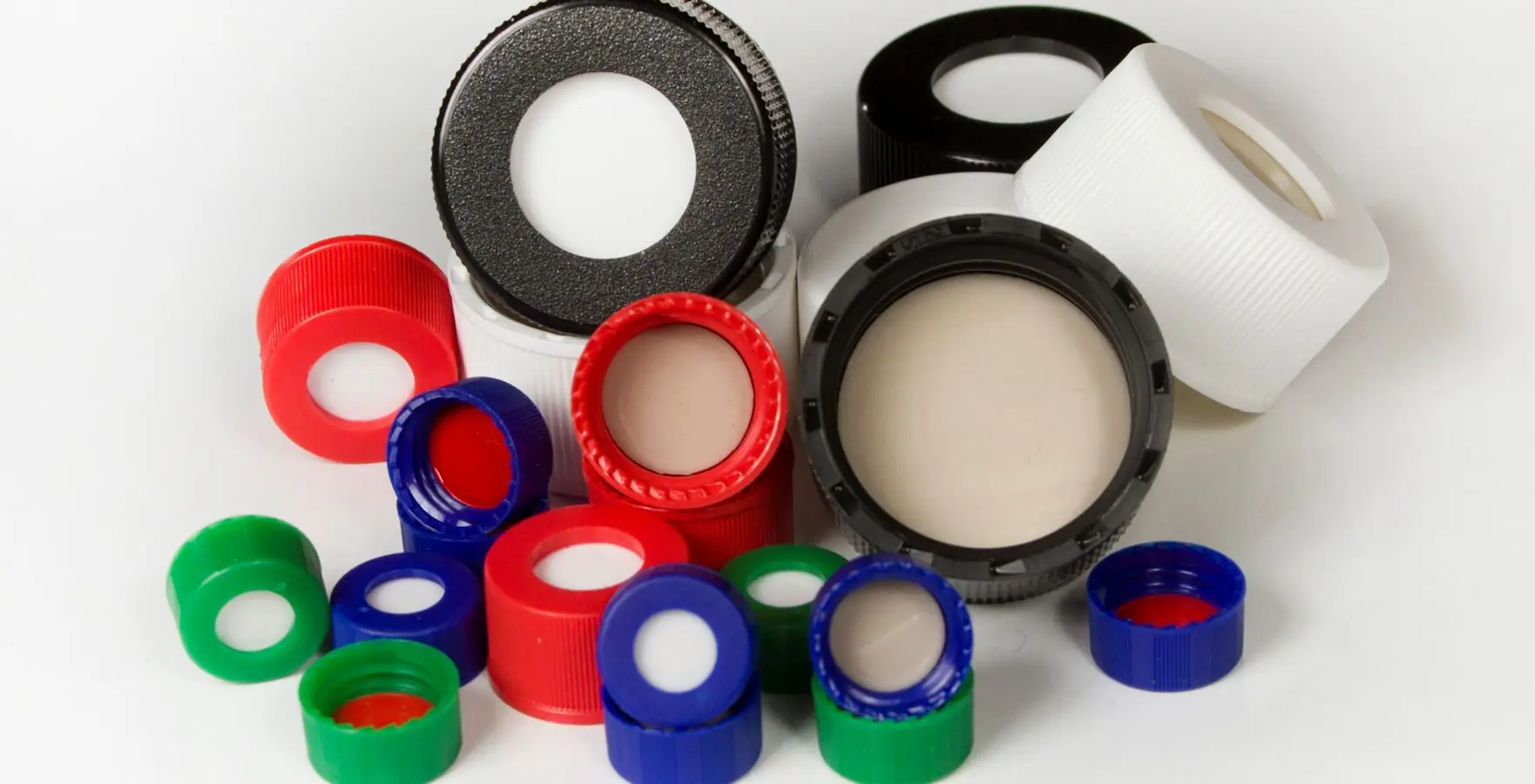
Chromatography vials are often treated as neutral bystanders, but they interact with samples more than many scientists realize. Glass quality, surface treatment, volume, and closure compatibility all influence recovery and reproducibility. Just as critical is the choice of the vial cap itself, including its size, design, and material.
Poor-quality glass can leach ions or adsorb analytes. An incorrect vial choice can increase evaporation or dead volume. Even the shape of the vial or insert bottom can affect autosampler precision. In the same subtle way, mismatched or poorly chosen caps can compromise sealing integrity, leading to evaporation, contamination, or inconsistent injection volumes, especially during long analytical sequences.
The choice between screw-top and crimp-top systems deserves particular attention.
- Screw caps may offer convenience, but they rely heavily on precise torque and proper thread engagement. An under-tightened screw cap may allow slow solvent loss, while over-tightening can deform the septum and affect needle penetration.
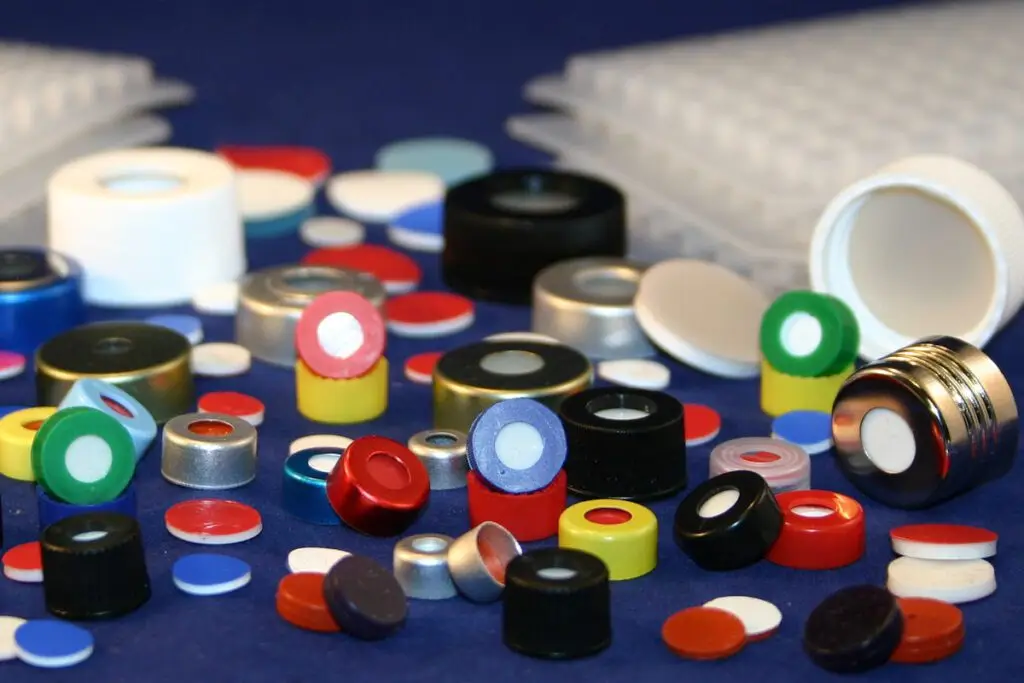
- Crimp caps, when properly sealed, provide consistent compression and excellent vapor containment, making them a preferred option for volatile compounds and GC septa Yet inconsistent crimping force or incorrect cap size can introduce variability.
Autosampler compatibility adds another layer of importance. Caps must align perfectly with autosampler needles, grippers, and trays. Caps that sit too high, too low, or deform under repeated puncture can cause mis-injections, bent needles, or skipped samples. What appears to be an autosampler issue is often a cap design or material problem in disguise.
Cap material selection is equally decisive.
- Aluminum caps offer excellent mechanical stability and include magnetic caps with a center hole (i.e., open top caps) for autosampler magnets.
- Plastic caps reduce corrosion risk but certain materials may be affected under heat or aggressive solvents. These include bonded caps with silicone septa.
Choosing the wrong material can lead to deformation, loss of septum compression, or chemical interaction with the sample. These effects are amplified in high-temperature workflows, such as GC, or when using strong organic solvents that challenge lower-grade plastics.
For trace analysis, these issues accumulate quickly. A slightly imperfect seal or marginal material choice may not cause immediate failure, but over dozens or hundreds of injections it quietly erodes reproducibility, turning minor inconsistencies into significant analytical noise.
Choosing vials and caps designed as a complete, compatible system for your application ensures that what you inject is truly what you prepared, not a distorted echo shaped by the container, the closure, and their interaction with the instrument. When vial, cap, and septum work in harmony, chromatography becomes more stable, more predictable, and far easier to trust.
High-Purity, Low-Bleed Silicone Septa: Quiet Control Over Noise and Drift
Among all chromatography consumables, septa have one of the most direct and underestimated impacts on chromatographic cleanliness. High-purity, low-bleed silicone septa are especially critical when working with sensitive detectors, trace-level analysis, or long analytical sequences.
“Bleed” refers to volatile or semi-volatile compounds released from the septum material under heat, solvent exposure, or repeated needle puncture. In GC and GC-MS, septum bleed can manifest as rising baselines, ghost peaks, or unexplained background signals that masquerade as real compounds. In LC and LC-MS workflows, extractables from low-quality septa can suppress ionization or introduce chemical noise that quietly erodes sensitivity.
High-purity silicone septa are engineered to minimize these extractables. They are produced with carefully controlled formulations and curing processes that reduce residual oligomers, plasticizers, and additives. The result is a septum that stays chemically quiet, even under demanding conditions. When the septum stops talking, your analytes can finally be heard.
Low-bleed performance is especially important in long sequences and overnight runs. As autosamplers repeatedly puncture the septum, inferior materials degrade, releasing particles and volatiles over time. This creates a subtle but progressive contamination that makes early injections look clean and later ones look suspicious. High-quality silicone septa are designed to withstand multiple punctures while maintaining elasticity, resealing ability, and chemical stability.
Another often overlooked factor is temperature resistance. Silicone septa formulated for high-temperature applications maintain integrity without hardening, cracking, or increasing bleed. This is crucial for GC inlets, heated autosamplers, and workflows involving aggressive solvents. A septum that survives the temperature but bleeds more as it heats up is only solving half the problem.
High-purity, low-bleed silicone septa also protect instrumentation. Reduced particle shedding means fewer clogged needles, fewer inlet liner replacements, and less contamination migrating downstream into columns and detectors. Over time, this translates into lower maintenance costs and more consistent performance across instruments and users.
In short, the right septum does not just seal a vial. It stabilizes the entire analytical system. By choosing high-purity, low-bleed silicone septa, laboratories gain cleaner baselines, more reliable quantification, and the confidence that what appears in the chromatogram truly belongs there.
Well Plate Cap Mats: High-Throughput Control Without Compromise
As laboratories increasingly shift toward high-throughput workflows, well plates have become central to sample preparation, storage, and injection. In this context, well plate cap mats play a role far more critical than simply covering wells. They are the primary barrier protecting sample integrity across dozens or hundreds of samples simultaneously, and their material quality directly influences data reliability.
One of the most important factors in cap mat performance is the purity of the silicone used in its construction. High-purity, low-bleed silicone cap mats are engineered to minimize extractables that can migrate into samples under heat, solvent exposure, or extended storage. In LC-MS and GC-MS applications, even trace levels of leached compounds can suppress ionization, elevate baselines, or introduce background peaks that complicate data interpretation. When multiplied across an entire plate, these effects quickly become systemic rather than isolated.
High quality silicone is especially important during long analytical sequences and repeated pierce cycles. Inferior materials may harden, tear, or shed particles after multiple punctures, leading to inconsistent resealing across wells. This results in variable evaporation rates, concentration drift, and, in worst cases, cross-contamination between adjacent wells. High quality silicone maintains elasticity and resealing performance, ensuring uniform sealing pressure well after the first injection.
Uniformity is another critical advantage of premium silicone cap mats. High purity materials can be molded with consistent thickness and hardness, allowing even sealing across the entire plate. This consistency prevents edge effects, where outer wells experience greater evaporation or weaker seals than those in the center. In quantitative workflows, eliminating these gradients is essential for maintaining plate-wide reproducibility.
Chemical resistance also becomes decisive when using aggressive organic solvents or mixed solvent systems. High purity silicone resists swelling, degradation, and extractable formation far better than lower-grade elastomers. This stability protects both the samples and the autosampler needles, reducing carryover, clogging, and maintenance interruptions.
Ultimately, a well plate cap mat made from high-purity, low-bleed silicone does more than seal wells. It stabilizes high-throughput workflows, protects sensitive analyses, and ensures that every well on the plate is treated equally. In modern chromatography, where scale and sensitivity often increase together, cap mats are not accessories. They are method-critical consumables.
The Bigger Picture: Chromatography Consumables as Method Partners
Chromatography methods do not exist in isolation. They live inside a physical ecosystem of chromatography consumables that either support or undermine them. When consumables are mismatched, scientists often chase problems through software settings, mobile phases, or detectors, while the real culprit sits quietly at the point of contact.
Choosing the right chromatography consumables is about respecting the full journey of the sample, from preparation to detection. Each component plays a role in preserving integrity, minimizing variability, and protecting instrumentation.
Conclusion: Precision Begins with the Basics
In a field driven by precision, the smallest components often carry the greatest responsibility. Columns define separation, vials preserve samples, septa guard integrity, and well plate cap mats ensure consistency at scale. Together, they form the foundation on which reliable chromatography is built.
Investing time in selecting the right consumables pays dividends in cleaner data, smoother workflows, and fewer surprises at 2 a.m. when a sequence goes sideways. In the end, great chromatography is not just about advanced instruments or clever methods. It is about making sure every detail, no matter how small, is working with you rather than against you.
Your samples deserve nothing less. For more information, contact SeptaSource.