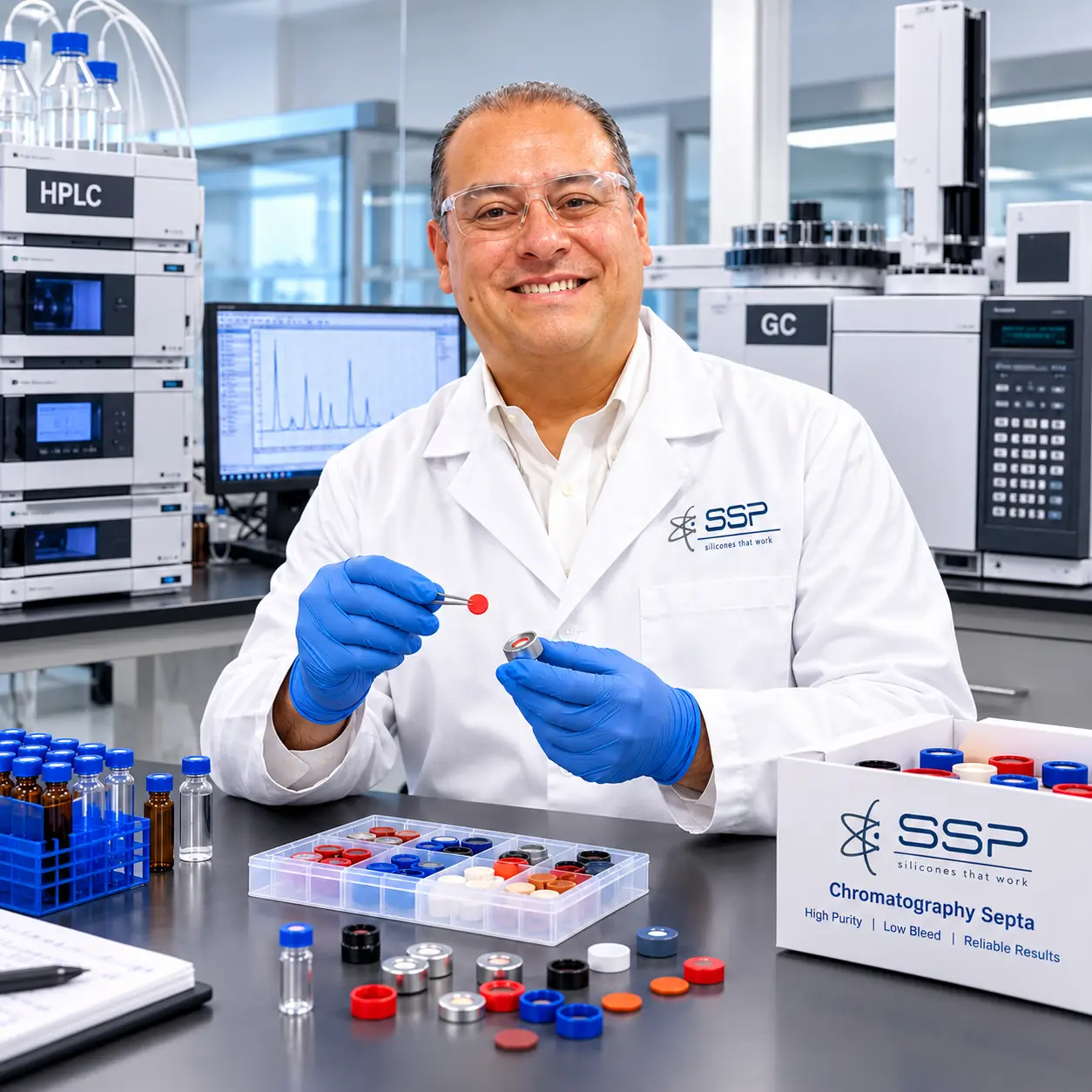
Specialty Silicone Products (SSP) provides answers to some frequently asked questions (FAQs) about silicone septum products.
What is a silicone septum?
A silicone septum is a precision‑molded sealing component used in chromatography vials, GC inlets, headspace vials, reagent bottles, and sterile sampling systems. It provides an airtight, resealable barrier that allows repeated needle punctures without compromising sample integrity.
Why is silicone the preferred material for septa?
Silicone is preferred because it combines elasticity, chemical resistance, and thermal stability. Silicone also exhibits low extractables, which helps maintain clean chromatographic baselines. Importantly, a silicone septum outperforms most elastomers due to its ability to reseal after puncture, resist coring, and maintain mechanical properties under heat and solvent exposure.
What is the difference between a silicone septum and a rubber septum?
A silicone septum offers superior thermal resistance, lower extractables, and better resealability than natural or synthetic rubber. Rubber septa are suitable for general laboratory use; however, silicone septa are preferred for chromatography, pharmaceutical sampling, and high‑purity applications due to their significantly lower extractables, which reduce the risk of leachables interfering with sample integrity and analytical results.
What is a PTFE‑lined silicone septum?
A PTFE‑lined silicone septum is a laminate consisting of a silicone base bonded to a thin PTFE film. The PTFE layer faces the sample and provides chemical inertness, while the silicone layer delivers resealability. This combination minimizes contamination, prevents sample absorption into the elastomer, and extends septum life during repeated injections.
When should I choose a PTFE‑lined silicone septum instead of unlined silicone?
Use a PTFE‑lined silicone septum when working with aggressive solvents, volatile organic compounds, or analytes that could interact with silicone. PTFE lining is also recommended for GC and HPLC autosampler vials, headspace vials, and any application where background contamination must be minimized.
How does a silicone septum prevent contamination?
A silicone septum maintains a vapor‑tight seal that prevents atmospheric exposure, evaporation, and particulate intrusion. Its resealing ability ensures that each needle puncture closes tightly around the needle track, reducing blow‑by leaks and protecting sample purity.
What durometer (hardness) is best for a silicone septum?
Most silicone septum products fall between 35–55 Shore A. Softer silicone improves resealability and reduces needle wear, while harder silicone resists coring and tearing. GC inlet septa often use slightly firmer silicone to withstand high temperatures and repeated injections.
How often should a silicone septum be replaced?
Replacement frequency depends on temperature, injection volume, and instrument type. In regulated chromatography workflows, septa are commonly designated as single-use consumables to control the risk of cross contamination and analytical carryover. GC inlet silicone septa may require replacement after 50–150 injections, while vial septa are used typically for a single analytical sequence. Septa should be replaced immediately if coring, leakage, discoloration, or any loss of sealing integrity is observed.
What causes coring in a silicone septum?
Coring occurs when small fragments of silicone are cut out by the needle tip. Common causes include:
- Dull or burred needles
- Excessively hard silicone septum materials
- High injection force
- Repeated punctures in the same location
- Incorrect needle bevel angle
Coring can contaminate samples or clog GC liners, so early detection is important.
Can a silicone septum withstand high temperatures?
Yes. High‑purity silicone septum materials tolerate GC inlet temperatures up to 300 °C, depending on formulation. PTFE‑lined versions offer additional thermal stability and reduced outgassing. For autoclave sterilization, silicone maintains elasticity and sealing performance after repeated cycles.
How should silicone septa be stored?
Store silicone septa in clean, dry, dust‑free containers away from oils and UV exposure. Avoid touching the PTFE‑lined surface with bare hands to prevent contamination. For long‑term storage, keep septa in sealed bags to maintain cleanliness.
What are the signs of a failing silicone septum?
Technicians should watch for:
- Visible cracks or brittleness
- PTFE delamination
- Discoloration or swelling
- Increased injection pressure
- Ghost peaks or baseline drift in GC
Any of these signs indicate that the silicone septum should be replaced immediately.
Can silicone septa be sterilized?
Yes. A silicone septum can be autoclaved, dry‑heat sterilized, or chemically sterilized depending on the application. PTFE‑lined versions tolerate sterilization well and maintain low extractables after repeated cycles.
What thickness should I choose for a silicone septum?
Common thicknesses range from 1–3 mm for vial septa and 3–5 mm for GC inlet septa. Thicker silicone septa provide better resealability and durability but require more needle force. Choose thickness based on instrument requirements and puncture frequency.
Are silicone septa suitable for headspace analysis?
Yes. A silicone septum is widely used in headspace vials because it maintains a gas‑tight seal under pressure and temperature cycling. PTFE‑lined versions prevent volatile analytes from interacting with the silicone layer.
What makes a high‑purity silicone septum different?
High‑purity silicone septa undergo controlled molding, post‑cure conditioning, and volatile removal to minimize extractables. These grades are essential for GC‑MS, pharmaceutical testing, and trace‑level environmental analysis.
For silicone septa you can depend on, contact us.